
Is your accounting system prepared for your business's BIR requirements?
As Philippine businesses move toward more digital financial processes, maintaining accurate accounting records, managing electronic invoices, and preparing for regulatory requirements have become important operational priorities.
For finance managers, business owners, and IT teams, these changes raise several questions:
- Can our existing accounting software support applicable BIR CAS requirements?
- Is our invoicing system prepared for the new electronic invoicing regulations?
- Do we need to replace our ERP, or can we integrate additional functionality?
- How do we choose an SAP implementation partner who understands Philippine compliance requirements?
Choosing the right SAP partner in the Philippines can help businesses answer these questions while establishing a stronger foundation for compliance, operational efficiency, and long-term growth.
Not sure whether your current accounting or invoicing system meets your business requirements?
Request a BIR CAS & EIS Solution Demo
In this guide, we explain what to look for in an SAP provider, how BIR CAS and EIS requirements affect technology decisions, and how to evaluate a solution before making an investment.
Why Choosing the Right SAP Partner Matters
Implementing an Enterprise Resource Planning (ERP) system is more than a software investment. It is a business decision that affects how financial information is recorded, processed, managed, and reported.
For growing Philippine businesses, relying on manual accounting, disconnected applications, or outdated systems may create challenges such as:
- Repetitive data entry and time-consuming reconciliation.
- Inconsistent financial information across departments.
- Difficulty preparing accounting records and reports.
- Limited visibility into sales, purchasing, and inventory.
- Challenges adapting existing processes to new regulatory requirements.
- Increased operational complexity as transaction volumes grow.
These challenges explain why businesses should evaluate a provider's implementation expertise, local knowledge, and ability to support long-term operational requirements.
The right SAP implementation partner should help your organization identify which processes need improvement, what regulatory obligations apply, and which technology approach best supports your business.
Understanding BIR CAS and EIS Requirements in the Philippines
Before choosing an SAP provider, it is important to understand the differences between BIR Computerized Accounting System (CAS) requirements and the Electronic Invoicing System (EIS) framework.
Although both relate to financial processes and regulatory compliance, they address different aspects of business operations.
What Is BIR CAS?
A Computerized Accounting System (CAS) integrates computerized processes for recording business transactions and generating accounting records, Books of Accounts, invoices, and financial reports.
Under BIR Revenue Memorandum Order (RMO) No. 9-2021, businesses adopting CAS, Computerized Books of Accounts (CBA), and covered system components must follow applicable registration and technical requirements.
Depending on the business and system configuration, important considerations may include:
- General Ledger and accounting records.
- Sales and purchase journals.
- Financial statements and management reports.
- Transaction histories and audit trails.
- Tax-related forms and supporting documentation.
- System descriptions and registration documents.
RMO No. 9-2021 simplified CAS registration procedures and replaced the previous general Permit to Use requirement for covered systems with a registration process involving an Acknowledgement Certificate.
However, an Acknowledgement Certificate does not automatically authorize the issuance of electronic invoices under the newer EIS rules.
Businesses should therefore evaluate both their accounting system requirements and their applicable electronic invoicing obligations.
Looking for BIR CAS-ready accounting software in the Philippines?
Explore APPTech's BIR CAS-Ready ERP Solution to learn how integrated accounting, financial reporting, and operational workflows can support your business.
What Is BIR EIS?
The Electronic Invoicing System (EIS) is part of the Bureau of Internal Revenue's digitalization initiatives involving structured electronic invoices and electronic sales data.
Unlike simply creating an invoice using a spreadsheet or converting a document into a PDF, compliant electronic invoicing involves requirements relating to structured data, approved software, electronic issuance, and the ability to extract and process invoice information.
For businesses evaluating a BIR EIS compliance solution, important factors include:
- Electronic invoice generation in an appropriate structured format.
- Accurate invoice details and transaction information.
- Electronic issuance and delivery to buyers.
- Integration with accounting or ERP data.
- Required permits, testing, and system certification.
- Proper handling of adjustments and system downtime.
The appropriate implementation depends on the taxpayer's regulatory coverage, existing software, and invoicing processes.
BIR EIS Deadline 2026: What Businesses Need to Know
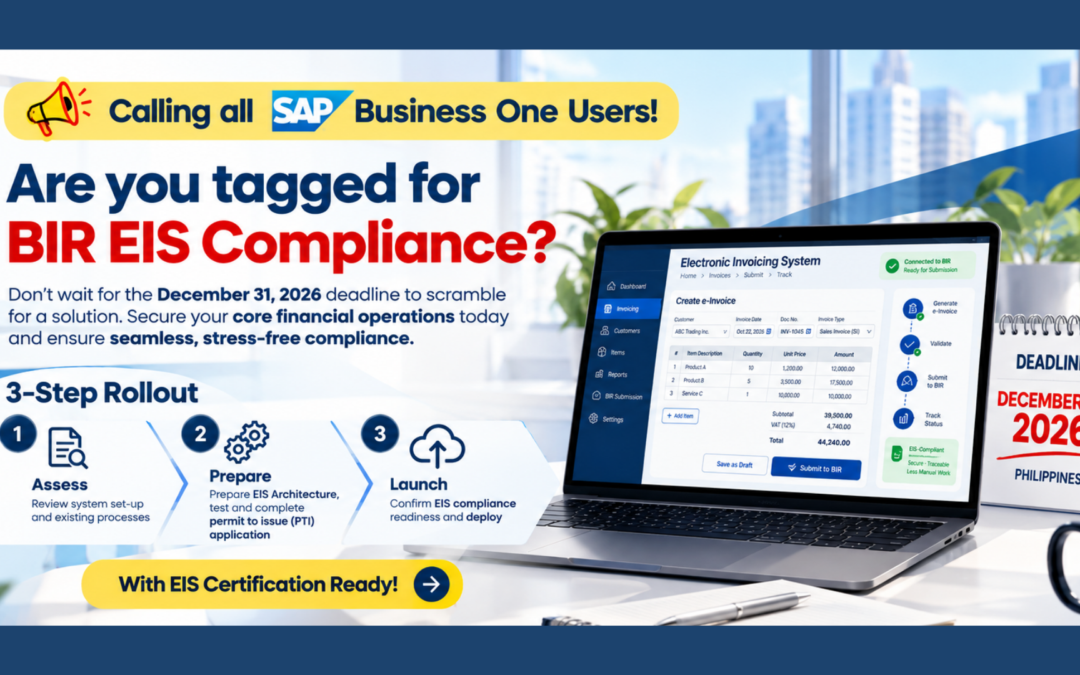
Under Revenue Regulations No. 11-2025, as amended by RR No. 26-2025, and Revenue Memorandum Circular No. 98-2026, covered taxpayers must comply with the applicable electronic invoice issuance requirements on or before December 31, 2026.
The covered groups include:
- Small, medium, and large taxpayers engaged in e-commerce or internet transactions.
- Taxpayers under the Large Taxpayers Service.
- Taxpayers classified as large under the Ease of Paying Taxes framework.
- Taxpayers using specified computerized accounting, computerized books, and electronic invoicing software arrangements.
- Other taxpayers specifically required by the Commissioner of Internal Revenue.
Micro taxpayers are excluded from the mandatory electronic invoicing coverage described in RMC No. 98-2026.
Importantly, electronic invoice issuance and electronic sales reporting are separate requirements. Electronic sales reporting is subject to separate implementing policies and procedures.
Covered taxpayers must also address the applicable Permit to Issue (PTI) Electronic Invoice and EIS certification requirements. Under RMC No. 98-2026, the certification is required within six months of PTI issuance.
Organizations should verify their specific obligations using current BIR issuances and qualified professional advice before finalizing their implementation plans.
With the December 2026 deadline approaching for covered taxpayers, assessing system readiness early can provide more time for evaluation, configuration, testing, and documentation.
1. Choose an SAP Partner With Philippine BIR Compliance Knowledge
Not every SAP provider offers the same experience with Philippine accounting and invoicing requirements.
When evaluating an SAP partner, consider whether the provider understands the relationship between ERP functionality and local regulatory obligations.
A knowledgeable implementation partner should be prepared to discuss BIR CAS registration considerations, applicable reports and accounting records, electronic invoicing requirements, and the responsibilities involved in system preparation and implementation.
It is equally important to understand the limits of the provider's services.
A software solution alone does not guarantee BIR compliance. The taxpayer remains responsible for meeting applicable obligations, including submissions and approvals.
Questions to ask a potential SAP partner:
- How does your proposed solution support our applicable BIR CAS requirements?
- Can you demonstrate the accounting records and reports our business needs?
- What assistance do you provide for system documentation and implementation preparation?
- How do you address electronic invoicing requirements and related changes?
A provider that can explain these topics clearly can help your organization make a more informed technology decision.
2. Evaluate SAP Business One and ERP Integration Capabilities
Some businesses need a complete ERP implementation. Others already use an ERP system and require additional functionality to address changing business or regulatory requirements.
Understanding this difference is essential.
SAP Business One is an integrated ERP solution designed primarily for small and midsize businesses. It supports core processes including accounting, sales, purchasing, inventory, and reporting.
When implemented appropriately, SAP Business One can provide a foundation for connected financial and operational processes.
However, organizations evaluating BIR EIS readiness should not assume that existing ERP functionality automatically meets all electronic invoicing requirements.
Additional configuration, integration, specialized applications, or approval activities may be necessary.
Already Using SAP Business One?
If your organization already operates on SAP Business One, replacing your entire ERP may not be necessary solely to address electronic invoicing requirements.
Instead, you can assess whether a suitable integration or add-on can support the required workflows.
For example, APPTech Experts offers an EIS Portal designed for SAP Business One environments.
The solution is intended to connect SAP Business One data with electronic invoicing processes, including structured invoice handling, validation, and related workflow requirements.
Its suitability, integration scope, and implementation requirements should be confirmed through an assessment and demonstration.
See how electronic invoicing can work with your SAP Business One environment.
Request an SAP Business One EIS Demo
3. Look for Relevant Industry and Implementation Experience
Every organization has different operational priorities.
For example, a manufacturing company may require production costing, material planning, purchasing controls, and inventory visibility.
A wholesale distributor may prioritize order processing, warehouse operations, supplier management, and financial reporting.
A retail organization may need visibility across inventory locations, sales channels, and customer transactions.
These differences can affect the scope and complexity of ERP implementation.
When choosing an SAP provider in the Philippines, ask whether the company has experience with organizations operating in similar industries.
Relevant industry knowledge can help the implementation team understand business processes, identify integration requirements, and anticipate challenges before deployment.
You should also review the provider's project methodology, customer references, implementation resources, and support arrangements.
4. Prioritize Financial Accuracy, Controls, and Reporting
For CFOs, finance managers, and accounting professionals, reliable financial information is essential.
Disconnected systems and repeated manual encoding can make reconciliation, reporting, and transaction monitoring more difficult.
When evaluating an SAP implementation partner, request a demonstration of the financial processes most relevant to your organization.
These may include:
- General Ledger and financial reporting.
- Accounts Payable and Accounts Receivable.
- Sales and purchasing transactions.
- VAT and withholding tax-related records.
- Books of Accounts and supporting reports.
- Audit trails and authorized user controls.
The specific features, outputs, and regulatory suitability depend on the chosen solution and its implementation.
A strong ERP implementation should support more reliable business information while helping finance teams reduce repetitive administrative work.
5. Consider Business Growth, Efficiency, and AI Readiness
While BIR compliance may be an immediate concern, businesses should also consider how their technology investments support future operations.
An ERP environment that connects essential processes can help organizations improve visibility, reduce duplicate encoding, and streamline information flow between departments.
As businesses expand, they may also require additional users, integrations, reporting tools, and automation capabilities.
When evaluating a prospective SAP partner, ask whether the proposed solution can support these future needs.
For organizations exploring artificial intelligence, reliable and appropriately governed business data is particularly important.
AI readiness begins with connected processes, accurate information, and suitable data controls.
Rather than selecting an ERP solution solely because it advertises advanced technology, evaluate whether the system provides a sustainable foundation for future digital capabilities.
6. Evaluate Implementation Methodology and Long-Term Support
Even an appropriate ERP solution can become difficult to manage without a clear implementation strategy.
Before selecting an SAP partner, understand how the provider plans to handle:
- Business requirements assessment.
- System configuration and integrations.
- Data preparation and migration.
- User acceptance testing.
- Training and change management.
- Go-live preparation and support.
- Maintenance and future enhancements.
Request a documented implementation scope and clarification of responsibilities.
For BIR CAS and EIS-related projects, discuss the activities involved in documentation, testing, permit preparation, certification readiness, and any coordination required with your accounting or compliance teams.
It is also important to review costs beyond the initial software quotation.
Depending on the solution, additional expenses may include subscriptions or licenses, configuration, integrations, training, maintenance, and support.
Transparent scope and cost discussions help businesses evaluate proposals more effectively.
7. Request a BIR CAS or EIS Solution Demo Before Deciding
Reading about software capabilities is useful, but seeing the system operate within a relevant business workflow can provide greater clarity.
A demonstration allows finance, accounting, operations, and IT stakeholders to evaluate the proposed solution before making an investment.
What Should You Expect During a BIR CAS Demo?
A useful demonstration may cover:
- How accounting transactions are recorded.
- How sales, purchasing, and inventory information connects with finance.
- How Books of Accounts and financial reports are generated.
- How audit trails and transaction records are maintained.
- Which BIR-related reports and outputs are supported by the proposed configuration.
What Should You Expect During a BIR EIS Demo?
An electronic invoicing demonstration should help your team understand:
- How invoice data is obtained from the existing ERP or accounting system.
- How the proposed solution generates structured electronic invoice information.
- How invoices are validated and issued electronically.
- How errors, adjustments, and relevant invoice statuses are handled.
- What testing, permit, certification, and implementation activities are required.
A valuable demo should answer your specific business questions rather than simply showcase generic product features.
Find out whether your business needs an ERP implementation, an electronic invoicing integration, or both.
Book a BIR CAS & EIS Solution Demo
How APPTech Experts Supports Philippine Businesses
At APPTech Experts, we help organizations evaluate ERP requirements, improve financial and operational processes, and implement SAP-based solutions aligned with their business needs.
Our services include SAP implementation, system integration, application support, and solutions designed around Philippine accounting and business requirements.
For organizations exploring BIR-related solutions, APPTech offers:
BIR CAS-Ready ERP Solutions
Support for businesses seeking a more structured accounting environment, including financial records, reports, operational integration, and relevant implementation activities.
Explore Our BIR CAS-Ready Solution
APPTech EIS Portal for SAP Business One
An electronic invoicing solution intended for SAP Business One environments, with implementation support for relevant invoice workflows and readiness activities.
Explore the APPTech EIS Portal
SAP Implementation and Ongoing Support
Consulting, implementation, integration, training, and technical support to help organizations manage ERP projects and evolving business requirements.
Explore SAP Implementation Services
Our approach begins with understanding your business processes, existing systems, reporting requirements, and implementation objectives before determining an appropriate solution.
Choose the Right Partner for Compliance, Efficiency, and Long-Term Growth
Selecting an SAP partner in the Philippines is not simply about choosing accounting or ERP software.
It is about finding a provider that understands your operational requirements, helps you evaluate applicable regulatory obligations, and supports your organization throughout implementation and beyond.
A well-planned technology investment should address three essential priorities:
Compliance: Establish accounting and invoicing processes that support your organization's applicable regulatory obligations.
Growth and Efficiency: Connect financial and operational activities to improve visibility, consistency, and productivity.
AI Readiness: Create a reliable digital foundation for future analytics, automation, and innovation.
Whether your organization is preparing for BIR CAS registration, evaluating EIS requirements, or planning a broader ERP implementation, informed decisions begin with understanding your current systems and business needs.
Ready to See the Right BIR CAS or EIS Solution for Your Business?
Managing compliance requirements with disconnected accounting and invoicing processes can make everyday operations more difficult.
Before investing in new software or changing your existing ERP, understand which solution best fits your organization's requirements.
APPTech Experts can help you explore your options through a solution demonstration focused on your existing systems and business workflows.
Discover how SAP-based accounting solutions and the APPTech EIS Portal may support your compliance preparation and operational goals.
Request Your BIR CAS & EIS Demo Today
APPTech Experts
Email: marketing@apptech-experts.com
Phone: +63 917 685 0862